Most of the food and consumer-goods cartons we make will be opened, filled, and closed by a machine. The machine has opinions about the carton. This article is about those opinions: what a horizontal cartoner needs from the blank, how we build a carton for a line we've never seen, how we match one for a line that's already running, and why a carton that ran fine in March can jam in September.
What is a horizontal cartoner, and what carton does it run?
A horizontal cartoner (also called an end-load or side-load cartoner) takes a flat, pre-glued carton from a magazine, opens it square, pushes the product in from the side, folds the end flaps, and seals them with hot melt or a tuck. Cereal, crackers, bars, frozen entrées, and most flow-wrapped or bagged food products run this way. The carton arrives at the plant already side-seamed, which is the gluing step we do here.
Two other formats show up regularly on food lines. Lock-style trays (Kliklok) and tri-seal cartons ship as flat, unglued blanks; the customer's forming machine erects them, either by folding locking tabs into slots or by gluing the corners on the machine. Frozen food, ice cream, and fresh meat such as brats and sausages are common examples. We die-cut both, and the machine does the rest. Of the two, lock-style trays are the less forgiving in our experience: with no glue to cover for a small error, the tabs have to hit the slots and hold on the first try, and the blank has to be very flat. A little bowing and the locks may not engage.
The rest of this article is about the pre-glued, end-load carton, because that's most of what we make.
What the machine needs from the blank
An end-load cartoner cares about a short list of things, and none of them have anything to do with how the carton looks on the shelf.
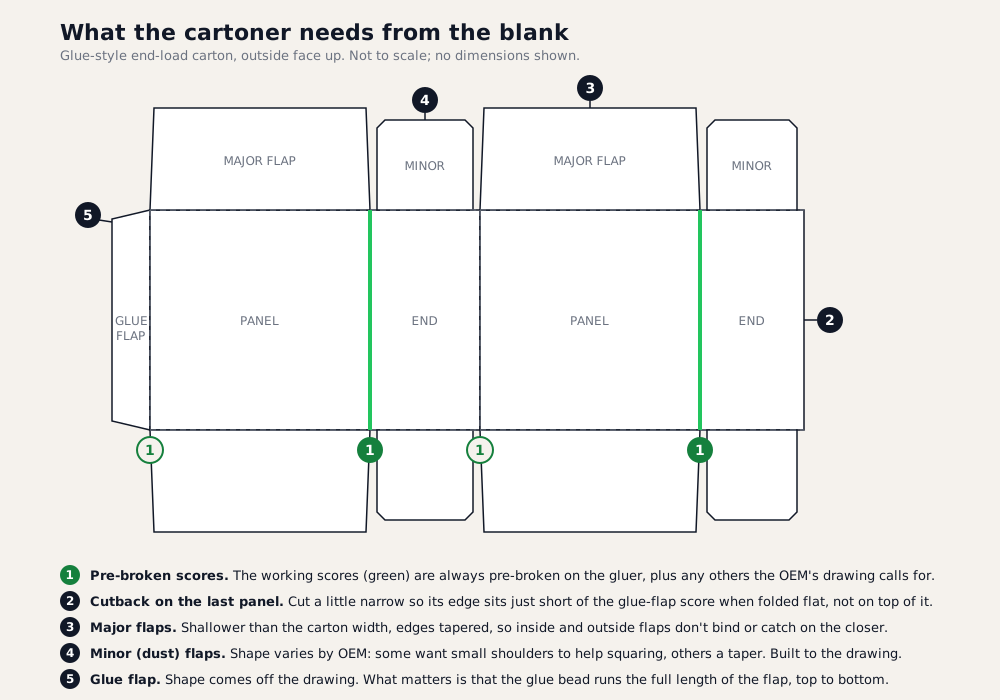
Scores that are pre-broken the way the machine expects. The feeder pulls a flat carton from the magazine and opens it, and the carton has to come up square in the transport chain. That depends on the scores being pre-broken on our gluer. As a standing practice we pre-break the two working scores, the ones the carton folds flat on, on every end-load carton, and we add whatever else the cartoner OEM, the company that built the machine, calls for in its drawing. On some machines that means all four panel scores. If a score is shallow, inconsistent, or cut through, the carton fights the feeder and arrives at the loader skewed instead of square. Score quality is the single most important thing we control.
A last panel that clears the glue-flap score. On any glued end-load carton, the last panel is cut back a little so that when the carton is folded flat, its edge sits just short of the score that forms the glue flap. Cut it the same width as the panel opposite and the edge can sit on top of that score, which can cause problems when the machine forms the carton. It's a small cutback and it's on every seal-end carton we make.
Flaps that clear each other. The major flaps are cut a little shallower than the carton width and tapered a few degrees at the edges, so the inside and outside majors don't bind against each other or catch on the closer plows. The minor (dust) flaps are the one feature that changes the most from one machine builder to the next. Some want small shoulders on them to help the carton square up; others want more of a taper. There isn't a standard dust flap, which is why we build to the OEM's drawing rather than a house shape. These are small dimensions, most of them under a sixteenth of an inch, and they are the difference between a flap that closes and a flap that crumples.
A glue bead that runs the full length of the flap. The width and taper of the glue flap come off the OEM's drawing. What matters more in the gluing department is that the bead runs from the very top of the flap to the very bottom. If glue is missing at either end, the corner of the carton isn't held and the machine can have trouble forming it, even though the carton looks sealed. That's why we still run glue wheels on this work: they're older technology than a glue gun, but they lay a continuous bead end to end, which a gun can miss at the top or bottom of the flap. Wheels take a little more maintenance and use a bit more glue, and they don't slow the gluer down. For a carton that has to run on a machine, that's an easy trade. Behind the wheel, every gluer has a W. H. Leary inspection system watching the glue seam, and a carton with the bead off is ejected before it reaches the case.
Board that stays flat. Warp is the magazine's enemy. A carton that has bowed in storage doesn't pick cleanly, doesn't pre-break evenly, and doesn't sit square in the chain. Board choice, grain direction, and how the cartons are packed and stored all matter here.
Most cartoner OEMs publish a construction drawing covering the machine-side geometry above, and they are clear about the boundary: they specify what the machine needs, and the carton supplier is responsible for the carton as a container for the product. We work to both.
How we build a carton for a new line
When a customer is installing a cartoner, or moving an existing product onto one, there's no reference carton to match, so the structure comes first. The style (seal end, tri-seal, lock tray) and the blank size are what drive the price, and those are usually known early. The machine-specific details are in the flap construction and the pre-break, and those need to be right before a die is cut, which is why the design goes to the OEM before it goes to tooling. That also means a customer can usually get a budget number early, with the understanding that an OEM with unusual requirements can occasionally move it.
The starting point is often a single sentence: the name of the machine builder, and nothing else. That's enough. From there we ask for the model and the OEM's carton construction drawing for that machine and carton style, and if the customer doesn't have the drawing, we get it from the OEM ourselves.
Our structural designer builds the blank to the machine drawing and we send the design to the cartoner manufacturer for approval. Once the OEM has signed off, the design goes to estimating and tooling. We also run a CAD sample so the customer can check fit and product clearance before we cut a die. Samples usually turn around in a couple of days.
When the machine is installed, we often go a step further and run a machine test: a quantity of unprinted cartons on plain coated board, cut and glued to the approved design, so the plant can run them on the cartoner and confirm the carton feeds, forms, and closes before anything goes on press. It's cheap insurance against finding a problem on the first printed lot.
How we match a carton to a line that's already running
A lot of the cartoner work we see isn't a new line. It's a plant that has a machine running and is changing carton suppliers, and the question is whether our carton will behave like the one that's already dialed in.
Our approach is to measure the incumbent rather than guess. We ask for a case of cartons that run well on the line. We measure the opening force on a Thwing-Albert score bend tester, which tells us how much the carton resists being opened at the scores, check the score depth, and verify the caliper, though the caliper is usually already known by then. Then we build our carton to match as closely as we can. A cartoner's pre-break and squaring sections are set up around that resistance. A carton that is noticeably stiffer or softer than the last lot will misfeed even if every dimension on the die line is correct.
Where the customer wants it, the same unprinted machine test applies here: a run of plain coated cartons built to match, trialed on the line before the printed order.
Why we ask for a sample even when you know the board
Customers often know the board spec: SBS, .018 caliper, say. We still want a physical carton, because caliper is thickness, and thickness doesn't tell you what the board is made of. Basis weight and stiffness do.
Two boards can both mic at .018 and be different boards. A sheet with a mechanical or thermomechanical pulp core is bulkier, so it reaches the same thickness at a lower basis weight. That's how folding boxboard (FBB) and similar grades are designed, and it isn't a defect; they're the standard board in much of the world outside North America and they increasingly get quoted into work here. But a lighter board at the same caliper creases, opens, and holds a pre-break differently, and that's precisely what a cartoner reacts to. The only way to know how a given carton will behave is to measure the one in front of you, which is what the opening-force test does.
This matters most when a running carton goes out for competitive bids. Two quotes can carry the same caliper and the same style and be for different boards, and the cheaper one can be on the lighter one. The price looks better. On the line, the misfeed rate and the downtime shrink the spread, and can erase it. When you're comparing bids on a carton that runs on a machine, ask every bidder for basis weight and MD/CD stiffness alongside caliper, so the comparison is between the same carton. We'll cover how to read those numbers on a board spec sheet in a follow-up.
"As closely as we can" is the honest phrase, and the reason is in the next section.
Fresh cartons, and why the same carton runs differently over time
Plant people talk about "fresh" cartons. They mean age. A carton off the gluer this week and the same carton after eight months in a warehouse are not the same carton. Paperboard fibers relax and the score memory fades as cartons sit. An older carton opens stiffer and doesn't hold its pre-break the way it did when it was new. Cartons are not like wine.
This is why a cartoner that was tuned on a fresh lot can start misfeeding on an older one, and why the first phone call usually goes to the converter. Humidity swings between the plant floor and the warehouse make it worse, and so does the change of seasons: it's not unusual to see cartoner problems show up in spring and fall when plant and warehouse conditions shift, with no change to the carton at all.
A few things follow from this:
- Aim for a 90-day cycle. Our working target is that the oldest carton in a customer's warehouse is about 90 days old. That isn't always reality, but it's a reasonable best practice to size orders around.
- Rotate carton stock. First in, first out matters more than most plants treat it.
- Tell your converter how old a reference case is. A carton that has been in the plant for most of a year is not the target to match; it's the problem being solved.
- Store cartons in the plant's climate, not on the dock or in a trailer, if you can.
- Check the lot date before assuming the carton changed. Sometimes it did. Often it aged.
Fresh cartons and the volume discount
The age problem is where procurement and the plant tend to disagree, and both are right about what they're measuring. Procurement sees a price per thousand that drops with quantity. The plant sees a jam rate that rises with carton age. Neither number shows up on the other's report.
Carton age is one version of this; board grade, from the section above, is another. A bigger order that sits in the warehouse costs something the invoice doesn't show: unplanned downtime, waste, supplier disputes over cartons that were in spec when they shipped, warehouse space, and the occasional pallet stranded by a design change. Whether the volume discount covers that depends on the product, the line, and the storage conditions, and it's a decision the customer should make with both numbers in view. When we quote, we're glad to show the price at the run size that hits the break and at the run size that fits a 90-day cycle, so that conversation can happen with real figures instead of a standoff between departments.
What to send us
For a new line: the cartoner make, the model if you know it, and the OEM's carton drawing if you have it. We'll design the carton and get the OEM's approval on it before we cut tooling. For an existing line: the same, plus a case of cartons that run well, with the lot date. Either way, we'll build a CAD sample before anything goes to press.